
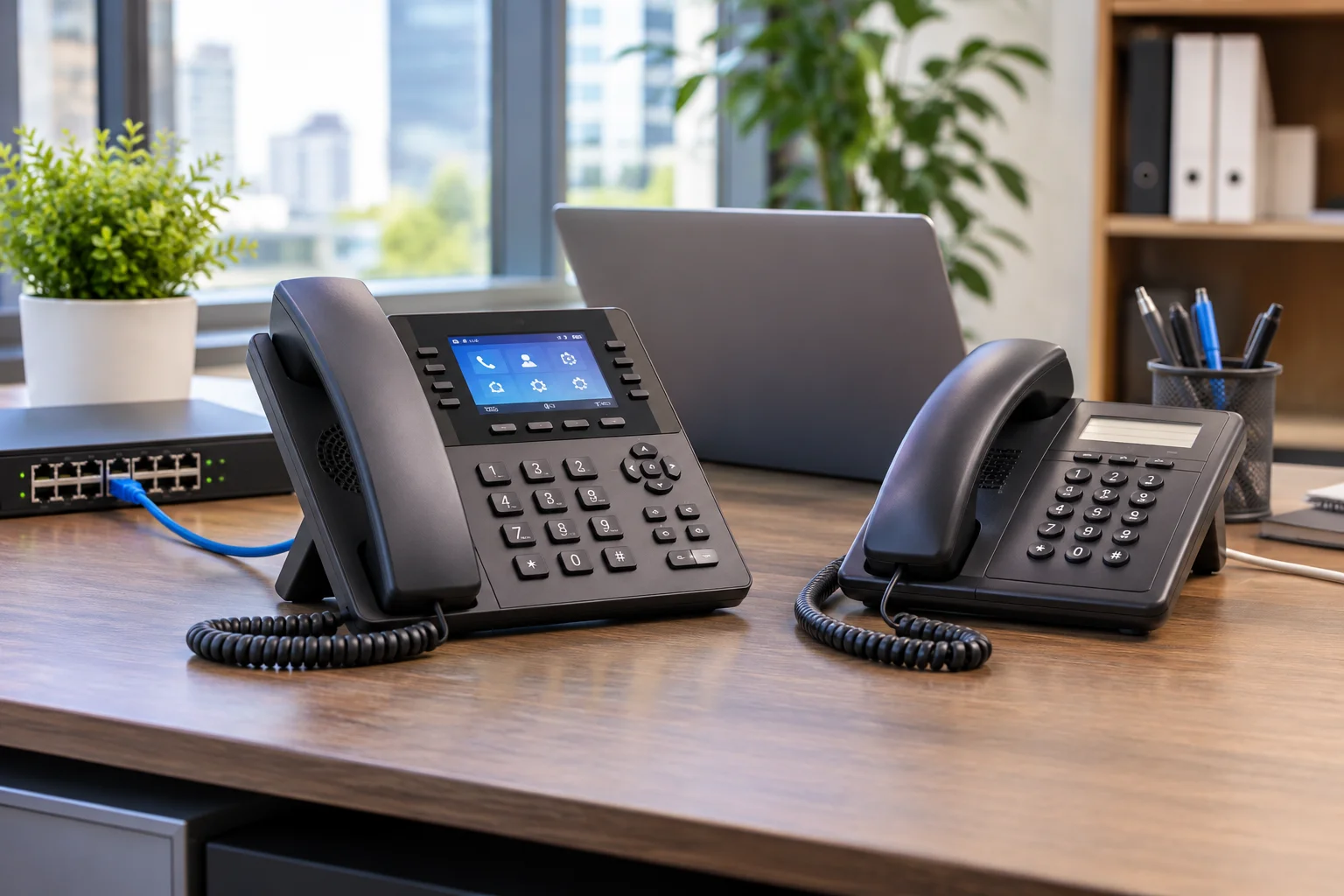
Choosing the right business phone system affects how customers reach your company, how employees communicate, and how much your business spends on phone service. While traditional landlines have served businesses for decades, Voice over Internet Protocol (VoIP) technology offers a different approach to handling business calls.
When comparing VoIP vs. landline phone systems, the decision is not simply about choosing newer technology over older technology. Businesses need to consider call quality, reliability, monthly costs, available features, internet connectivity, existing equipment, and the ability to support future growth.
For many modern offices, VoIP offers greater flexibility and a wider range of communication features. However, traditional landline systems may still make sense in certain environments where internet connectivity is unreliable or existing telephone infrastructure meets specific operational requirements.
Understanding how these systems work and where their differences matter can help you make a more informed decision for your business.
What Is VoIP?
Voice over Internet Protocol, commonly known as VoIP, is a phone technology that transmits voice calls over an internet connection rather than relying on traditional telephone circuits.
Instead of connecting every telephone to a dedicated phone line, a VoIP system converts voice audio into digital data and sends it across an IP network. Depending on the system, employees can make and receive calls using desk phones, computers, mobile devices, or dedicated applications.
Business VoIP systems can also provide features that help companies manage incoming and outgoing calls more efficiently, including:
- Call forwarding and routing
- Auto-attendants and virtual receptionists
- Voicemail and voicemail-to-email notifications
- Call queues and ring groups
- Conference calling
- Business extensions
- Mobile and remote calling
- Call reporting and analytics
These features can help businesses manage customer inquiries, direct calls to the appropriate employees, and maintain communication across different departments or locations.
For companies evaluating a new system, business phone systems can provide a foundation for more organized communication, particularly when the company needs multiple extensions or flexible call routing.
What Is a Traditional Landline Phone System?
A traditional landline phone system generally uses physical telephone infrastructure to connect calls. Legacy analog telephone service commonly relies on copper wiring and the traditional telephone network, also known as the Public Switched Telephone Network (PSTN).
Businesses may use individual telephone lines or an on-premises Private Branch Exchange (PBX) to manage multiple phones and extensions. A PBX allows employees to communicate internally and share incoming and outgoing telephone lines without requiring a separate external line for every employee.
Traditional business phone systems can provide dependable voice communication, particularly when the existing infrastructure is well maintained and the business has straightforward calling requirements.
However, older systems may have limitations when businesses need to add employees, support remote workers, introduce advanced call management features, or connect multiple offices.
It is also important to understand that the term “landline” does not always mean a traditional copper connection. Some modern fixed telephone services use fiber, cable, or other technologies. Businesses should confirm exactly how their current service is delivered before comparing it with VoIP.
VoIP vs. Landline: Key Differences
Although both systems allow businesses to make and receive telephone calls, they differ in how calls are transmitted, how the infrastructure is maintained, and how easily the system can adapt to changing business requirements.
| Comparison | VoIP Phone System | Traditional Landline |
|---|---|---|
| Call transmission | Voice data travels over an IP network | Traditional analog service uses telephone circuits and physical lines |
| Internet dependency | Requires a suitable internet or IP network connection | Traditional copper service does not depend on the business internet connection |
| Infrastructure | Network equipment, compatible phones, and internet connectivity | Telephone wiring, phone lines, and potentially on-premises PBX equipment |
| Adding employees | Users and extensions may be added through system configuration | May require additional lines, wiring, hardware, or provider arrangements |
| Remote access | Can support calling from compatible mobile devices and computers | Generally tied to the physical phone or location unless additional services are configured |
| Call management | Often supports advanced routing, queues, auto-attendants, and reporting | Features depend on the line service and PBX equipment |
| Power requirements | Network equipment and phones require power | A basic line-powered analog phone may work during a power outage, depending on the service and infrastructure |
| Maintenance | May involve network configuration, provider management, and compatible equipment | May involve telephone wiring, line maintenance, and legacy PBX support |
| Scalability | Generally easier to expand without installing new physical telephone lines | Expansion may require additional infrastructure or equipment capacity |
The right choice depends on which of these differences matters most to your business. A small office with a few fixed phones may have different requirements from a company with several departments, remote employees, or multiple locations.
Cost Comparison: VoIP vs. Landline
Cost is one of the most important factors when comparing VoIP vs. landline phone systems for business. However, businesses should evaluate the total cost of ownership rather than comparing only the advertised monthly service price.
Traditional Landline Costs
Traditional business telephone service may involve costs associated with:
- Monthly telephone line rental
- Additional lines for employees or departments
- Long-distance calling charges
- Telephone equipment and PBX hardware
- Installation and telephone wiring
- Maintenance and repairs
- Additional calling features or service packages
Businesses using an older PBX may also need to consider replacement parts, maintenance agreements, and the cost of upgrading equipment when the existing system reaches the end of its useful life.
VoIP Costs
VoIP pricing varies depending on the provider, the number of users, the features included, and the type of equipment required. Common expenses may include:
- Monthly service subscriptions
- IP desk phones, headsets, or compatible devices
- Installation and configuration
- Internet service or bandwidth upgrades
- Network improvements, if required
- Optional features, integrations, or additional services
Some businesses can use existing computers or mobile devices with a VoIP application, while others may prefer dedicated desk phones. The equipment requirements depend on how employees work and how the phone system is configured.
Which System Is More Affordable?
VoIP may reduce ongoing telephone expenses for businesses that have multiple lines, frequent long-distance calls, or costly legacy equipment. It can also reduce the need to install additional physical telephone lines when the business expands.
However, switching to VoIP is not automatically less expensive in every situation. A company with an existing telephone system, a small number of lines, and minimal calling requirements may find that replacing its equipment and upgrading its network creates additional upfront costs.
Before making a decision, compare the current monthly telephone bill, equipment maintenance, installation costs, internet requirements, and the expected cost of adding employees or features over time.
Reliability and Call Quality
Both VoIP and traditional landline systems can provide reliable business communication when properly configured and supported. Their reliability depends on different factors, which businesses should understand before choosing a system.
VoIP Reliability
VoIP call quality depends on the performance of the internet connection and the network carrying voice traffic. Network congestion, insufficient bandwidth, latency, jitter, packet loss, and improperly configured equipment can affect calls.
A business with a stable broadband connection and a properly configured network can support clear VoIP conversations. However, businesses should assess their internet connection before moving their primary telephone service to an internet-based system.
Network quality is particularly important when employees use the same connection for voice calls, video conferencing, cloud applications, file transfers, and other business activities.
Landline Reliability
Traditional copper telephone service has historically offered an advantage in certain outage situations because a basic analog telephone may receive power through the telephone line rather than depending on the electricity supplied to the office.
This advantage does not apply to every modern fixed telephone service or every telephone device. Cordless phones, digital telephone services, fiber-based voice services, and equipment connected through powered systems may require electricity to operate.
Landline service can also be affected by damaged telephone cables, network failures, equipment problems, or provider outages.
How Businesses Can Improve VoIP Reliability
Businesses considering VoIP should evaluate their network and plan for possible interruptions. Depending on operational requirements, reliability measures may include:
- Using a business internet connection that meets the system’s requirements
- Configuring network equipment to prioritize voice traffic where appropriate
- Providing backup power for critical network equipment
- Considering a secondary internet connection
- Configuring call forwarding or mobile failover where supported
- Testing the system during network interruptions
These measures can help reduce communication disruptions and give businesses more options when their primary connection is unavailable.
Features and Flexibility for Businesses
One of the biggest differences between VoIP and traditional landline systems is the range of call management features available. Modern business VoIP platforms can offer tools that help employees manage calls, support customers, and communicate across departments.
Call Routing and Auto-Attendants
VoIP systems can route incoming calls based on business hours, departments, employee availability, or other configured rules. An auto-attendant can greet callers and direct them to the appropriate extension without requiring a receptionist to answer every call manually.
These capabilities can be particularly useful for businesses receiving calls from customers, vendors, and multiple departments throughout the day.
Mobile and Remote Calling
Many business VoIP systems allow employees to make and receive business calls through compatible mobile applications or computers. This can help employees remain reachable when working remotely, traveling, or moving between locations.
Employees may also be able to use their business extensions outside the office without relying on a telephone physically installed at their desk.
Voicemail and Call Management
VoIP systems may provide voicemail notifications, voicemail-to-email, call queues, ring groups, call forwarding, and other features that help businesses manage incoming calls.
Availability depends on the service plan and system configuration. Businesses should confirm which features are included before choosing a provider.
Integration With Business Tools
Some VoIP platforms support integration with customer relationship management systems, business applications, and other communication tools. These integrations may help employees access customer information or manage communication activities from connected applications.
Businesses that rely heavily on customer support, sales calls, or centralized communication may find these capabilities particularly useful.
VoIP vs. Landline for Small Businesses
Small businesses often have different telephone requirements depending on the number of employees, the volume of incoming calls, and how customers interact with the company.
A traditional landline may be suitable for a small office that uses only one or two phones, has straightforward calling requirements, and already has reliable telephone infrastructure in place.
However, a small business experiencing growth may benefit from VoIP because the system can support multiple extensions, call routing, mobile access, and additional employees without relying on the installation of a separate physical telephone line for each user.
For example, a business with a receptionist, sales team, customer service department, and employees working remotely may need more than basic telephone service. A properly configured business phone system can help route incoming calls, allow employees to share responsibility for answering calls, and provide more flexibility as the company grows.
The important consideration is not the size of the business alone. It is whether the phone system can support the company’s communication needs without creating unnecessary costs or operational complications.
When Should a Business Switch From Landline to VoIP?
Switching to VoIP may make sense when the limitations of an existing telephone system begin affecting daily operations or when the business needs capabilities that its current system cannot provide.
Consider evaluating a VoIP system if your business:
- Is adding employees, departments, or office locations
- Needs more extensions or better call routing
- Has employees who work remotely or travel frequently
- Wants calls to be answered outside normal office hours
- Needs a more flexible way to manage incoming customer calls
- Is paying significant maintenance costs for an older PBX system
- Needs features such as call queues, voicemail notifications, or mobile calling
- Is planning an office relocation or telephone system upgrade
- Wants to review its current communication expenses
Businesses should also consider whether their existing telephone provider is changing or discontinuing a legacy service. Traditional copper telephone networks are undergoing modernization, and availability can vary by provider and location. Businesses relying on older telephone infrastructure should confirm their service options and any planned changes with their provider before making decisions.
What Should You Consider Before Choosing a Business Phone System?
Before selecting VoIP or a traditional landline, evaluate how your business uses its phones and what it needs from its communication infrastructure.
1. Number of Employees and Extensions
Determine how many employees need phones, how many calls your business handles simultaneously, and whether departments need dedicated extensions or shared call groups. A system should support your current requirements while allowing reasonable expansion.
2. Existing Equipment and Infrastructure
Review your existing phones, PBX equipment, telephone wiring, internet connection, and network infrastructure. Some businesses may be able to reuse compatible equipment, while others may need upgrades or replacements.
3. Internet Performance
If you are considering VoIP, evaluate the reliability, bandwidth, and performance of your internet connection. A phone system should not be selected without considering the network that will support it.
4. Business Continuity
Consider what happens if your internet connection, electrical power, or telephone service becomes unavailable. Determine whether your business needs backup power, alternative connectivity, call forwarding, or another communication method for critical operations.
5. Features and Call Handling
Identify the features your business actually needs. Call routing, voicemail, auto-attendants, call queues, mobile access, and conference calling may be important for some companies but unnecessary for others.
6. Future Expansion
Think about whether your company expects to add employees, departments, locations, or new communication requirements. Choosing a system that can adapt to these changes may help avoid another major upgrade in the near future.
Businesses evaluating their options can explore voice and PBX systems to better understand the equipment, infrastructure, and configuration considerations involved in a business telephone system.
Is VoIP Better Than a Landline for Your Business?
For many businesses, VoIP offers a practical combination of flexibility, call management features, and scalability. It can be particularly useful for growing offices, businesses with multiple departments, companies supporting remote employees, and organizations that want to manage calls through a more adaptable system.
Traditional landlines may still be appropriate for businesses with simple calling requirements, dependable existing telephone infrastructure, limited need for advanced features, or specific operational requirements that favor their current service.
Neither option is automatically the right choice for every company. The best phone system is the one that supports your employees, provides dependable communication, fits your budget, and meets your business’s operational requirements.
If your business is planning a telephone system upgrade, office expansion, or infrastructure improvement, reviewing your existing setup before selecting a solution can help you make a more informed decision.
NewCom Solutions provides business communication and infrastructure services, including business phone systems, voice and PBX systems, structured wiring, and cable installation.
To discuss your business’s telephone system requirements, schedule a conversation with NewCom Solutions.
Frequently Asked Questions About VoIP vs. Landline
Is VoIP better than a landline for business?
VoIP may be a better fit for businesses that need flexible call routing, mobile access, advanced features, and easier expansion. Traditional landlines may still suit businesses with simple calling requirements or specific infrastructure needs. The best choice depends on the company’s internet reliability, budget, equipment, and communication requirements.
Is VoIP cheaper than a landline?
VoIP may cost less over time, particularly for businesses with multiple users, frequent long-distance calls, or expensive legacy telephone equipment. However, total costs depend on service pricing, equipment, installation, internet requirements, maintenance, and the features the business needs.
Is VoIP reliable for business?
VoIP can provide reliable business communication when supported by a stable internet connection, properly configured network equipment, and an appropriate service provider. Businesses should also plan for power or internet interruptions through backup connectivity, power supplies, or call forwarding where available.
Can VoIP phones work without internet?
Most VoIP systems require an internet or IP network connection to complete calls. If the primary connection becomes unavailable, calls may not work unless the system has a configured backup connection, mobile failover, or another supported alternative.
What is the difference between VoIP and an analog phone system?
An analog phone system traditionally transmits voice through telephone circuits and physical telephone lines. VoIP converts voice into digital data and transmits it over an IP network. This difference affects infrastructure, connectivity requirements, features, and how each system can be expanded.
Can a business keep its existing phone numbers when switching to VoIP?
In many cases, businesses can transfer existing telephone numbers to a VoIP provider through a process known as number porting. Eligibility, timing, and requirements depend on the numbers, current provider, and receiving service. Businesses should confirm the porting process before disconnecting existing telephone service.
Should a small business switch from landline to VoIP?
A small business should consider switching if it needs more extensions, better call management, mobile access, easier expansion, or a more flexible communication system. Businesses should first review their internet connection, current equipment, telephone expenses, and operational requirements to determine whether the change makes sense.